
Joining forces with the Gullah/Geechee Culture Community Trust (GGCT), Spenser Anderson of SEIU, and University of Miami at the North American Cartographic Information Society (NACIS) conference allowed us to present a unified narrative on the threats facing Gullah/Geechee cultural resources, including vital sites like Crandall Cemetery. Our collaboration was driven by a shared, non-negotiable belief: community knowledge must be held in the exact same esteem as technical and institutional expertise. Beyond our research, it was a profound honor to facilitate GGCCT in delivering their incredible presentation. While I could not be there in person, supporting Glenda Simmons Jenkins and Kathie Carswell as they stepped into that room and commanded the space with confidence was a realization of a core, non-negotiable belief of my practice: community knowledge must be held in the exact same esteem as technical and institutional expertise.
The thread connecting our studies was the overwhelming impact of localized development pressures on biocultural heritage. Spenser’s & GGCT work mapped how industry-driven development in Nassau County, such as the conversion of timber lands into subdivisions, actively threatens Gullah/Geechee communities through land loss and environmental hazards.
My research at American Beach expanded on this by demonstrating how national screening tools systematically mask these localized development threats. By aggregating demographic data alongside adjacent resort wealth, these tools erase the socio-economic burdens of underrepresented coastal communities. To counter this statistical erasure, I developed a Relational Value Score (RVS) to quantify community cultural resilience directly against regulatory development vulnerabilities.
Together, our presentations made one definitive statement: development, if not consciously done with the community, results in the tragic loss of both the tangible and intangible heritage of our communities.
I would encourage you all to see the lovely video they made on the presentation which can be found here.
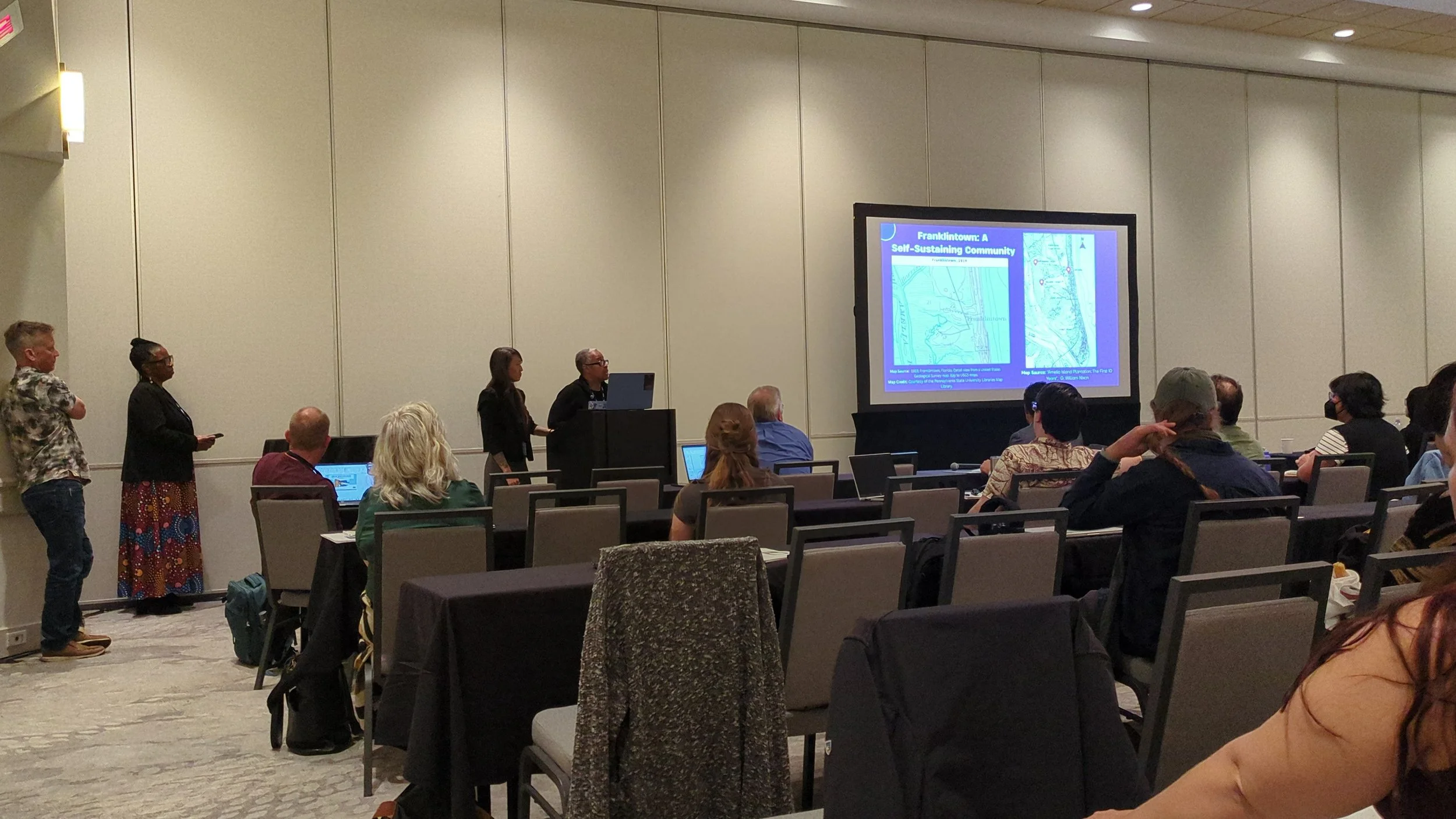
GGCCT presenting on Gullah/Geechee cultural history and the continued need to integrate technical approaches for assessing the locations and extents of cultural resources. Courtesy of Spenser Anderson.